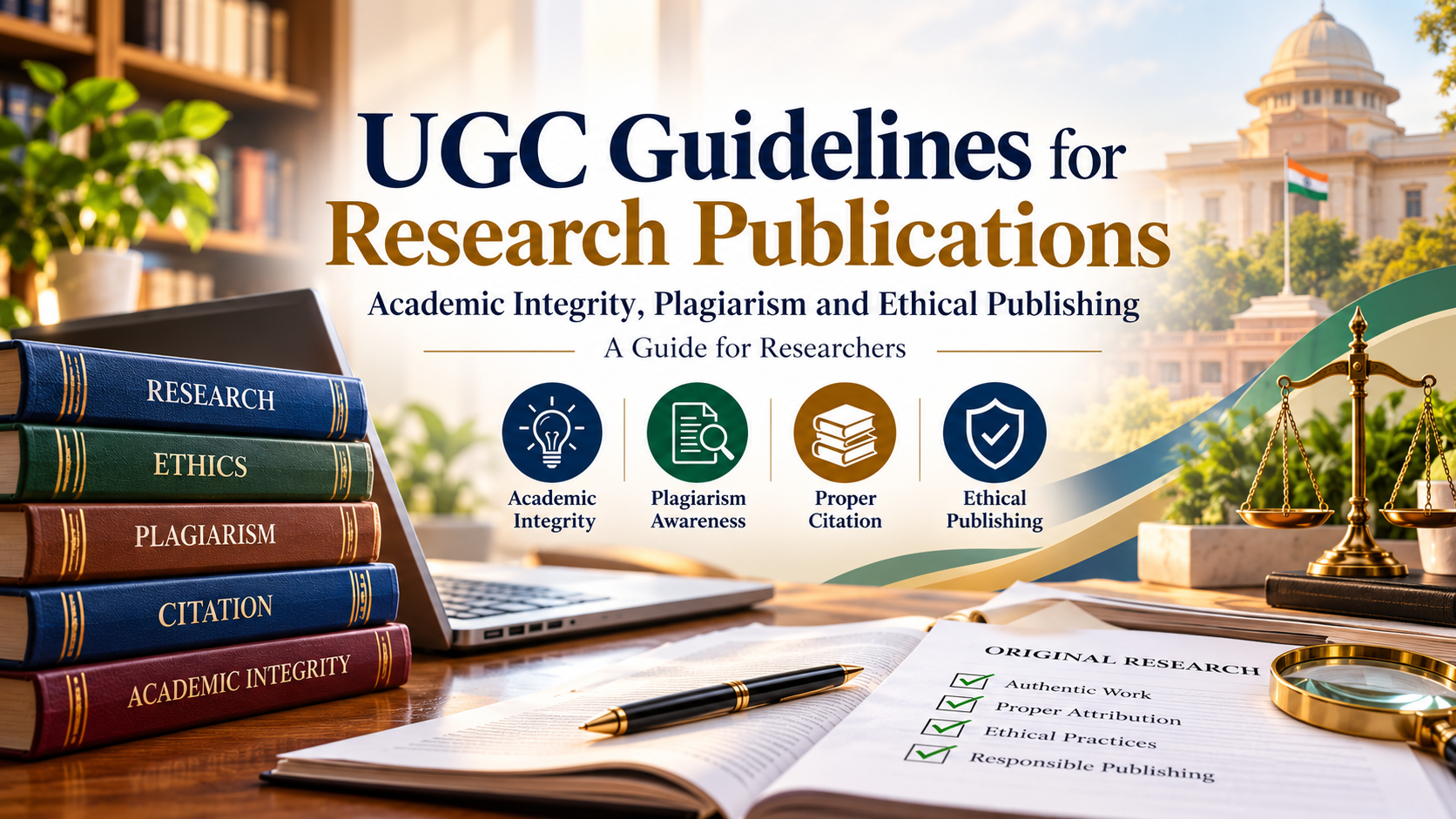
Research is built on trust. Every research paper, thesis, dissertation, book chapter or scholarly publication is expected to represent original work, acknowledge the contribution of others and follow accepted standards of academic integrity
In India, the University Grants Commission (UGC) has established an important framework for promoting academic integrity and preventing plagiarism in higher education. For researchers and authors, understanding these principles is an essential part of responsible scholarly publishing
What Does Academic Integrity Mean?
Academic integrity refers to honesty, transparency and responsibility in academic and research work
According to the UGC (Promotion of Academic Integrity and Prevention of Plagiarism in Higher Educational Institutions) Regulations, 2018, academic integrity involves intellectual honesty in proposing, performing and reporting activities that lead to the creation of intellectual property
For researchers, this means that a manuscript should accurately represent the work carried out by the authors and appropriately acknowledge ideas, words, data and findings taken from other sources
Academic integrity is not limited to plagiarism checking. It extends to the entire research and publication process
Understanding Plagiarism in Research
Plagiarism occurs when someone else's work or ideas are presented as one's own without appropriate acknowledgement
It may involve copying text, using another researcher's ideas without citation, reproducing data without acknowledgement, or presenting previously published material in a misleading manner
Similarity and plagiarism, however, should not always be treated as identical concepts. A similarity report identifies matching text, while determining whether plagiarism has occurred requires academic and editorial judgement
References, properly quoted material and certain commonly used expressions may create similarity without necessarily constituting plagiarism
UGC Similarity Levels
Under the UGC Regulations, 2018, plagiarism is classified into different levels based on similarity:
- Level 0: Similarities up to 10% - Minor similarities
- Level 1: Similarities above 10% to 40%
- Level 2: Similarities above 40% to 60%
- Level 3: Similarities above 60%
These levels form part of the UGC framework applicable to Higher Educational Institutions and should not automatically be interpreted as universal acceptance limits for every academic journal
Individual journals may establish their own editorial screening requirements and may apply stricter standards depending on their publication policies
Why Plagiarism Screening Matters
Plagiarism screening helps protect the credibility of scholarly literature
The UGC framework requires Higher Educational Institutions to establish mechanisms for checking research work for plagiarism. Similarity-detection tools can assist researchers, supervisors and editors in identifying potentially problematic overlap before publication
However, software-generated percentages should not replace editorial judgement. A responsible assessment considers where the similarity occurs, what material has been matched, whether appropriate citations have been provided and whether the overlap affects the originality of the research
Proper Citation and Referencing
Authors must acknowledge sources whenever they use another person's ideas, arguments, data, findings or words
Proper referencing allows readers to trace the intellectual foundation of a study and distinguishes an author's original contribution from previously published knowledge
Authors should therefore follow the citation and reference style required by the journal and verify the accuracy of references before submission
Incomplete, misleading or fabricated references can undermine the reliability of a research article
Originality of Research
A manuscript submitted for publication should make an original scholarly contribution
Authors should avoid submitting substantially the same manuscript to multiple journals simultaneously. Previously published material should not be presented as new research without appropriate disclosure and justification
Researchers should also maintain transparency regarding the origin of data, methodology and previously published work related to the manuscript
Responsible Authorship
Authorship carries both academic credit and responsibility
Individuals listed as authors should have made meaningful contributions to the research or manuscript and should be able to take responsibility for their contribution
Adding individuals who have not made a genuine scholarly contribution, or excluding individuals who have made substantial contributions, can raise serious publication-ethics concerns
The corresponding author also has an important responsibility to ensure that the manuscript information and author details supplied to the journal are accurate
Conflict of Interest
Authors should disclose financial, professional, institutional or personal interests that could reasonably influence or appear to influence the research or its interpretation
A conflict of interest does not necessarily make research invalid. Transparent disclosure allows editors and readers to evaluate the work with appropriate context
Research Ethics and Transparency
Where research involves human participants, animals, sensitive information or other areas requiring ethical oversight, authors should comply with applicable institutional, legal and disciplinary requirements
Where applicable, information concerning ethical approval, informed consent, funding and related declarations should be provided transparently
Ethical research publication depends not only on the final manuscript but also on how the underlying research was conducted
The Role of Peer Review
Peer review is an important quality-control mechanism in scholarly publishing
Reviewers evaluate research for academic relevance, methodology, clarity, originality and contribution to the field. Editors then use these assessments, together with their own evaluation, to make publication decisions
Peer review should be conducted independently, confidentially and without inappropriate influence
Authors should respond to reviewer comments carefully and transparently when revisions are requested
How BJDD Promotes Research Integrity
The BODHIVRUKSHA JOURNAL OF DIVERSE DISCIPLINE (BJDD) is committed to responsible scholarly communication and publication ethics
BJDD's editorial practices are designed to support principles of academic integrity, originality, transparent editorial evaluation and ethical publication
Manuscripts submitted to BJDD are expected to be original and unpublished. Submissions may undergo preliminary editorial screening, plagiarism/similarity assessment and peer-review procedures in accordance with the journal's current policies
BJDD also expects authors to provide accurate authorship information, appropriately acknowledge sources, disclose relevant conflicts of interest and comply with applicable ethical requirements
Where concerns regarding originality, authorship, ethical compliance or research integrity arise, the Editorial Office may request clarification, supporting documents or revision before a final publication decision is made
BJDD may maintain journal-specific editorial standards that are stricter than general similarity classifications described under the UGC framework. Authors should therefore always refer to the latest BJDD Author Guidelines and Publication Ethics policies before submitting a manuscript
A Note for Authors
Publication should not be viewed simply as adding another paper to an academic profile
Responsible research publication means contributing reliable knowledge to the scholarly community
Before submitting a manuscript, authors should ask:
Is the work genuinely original?
Have all sources been properly acknowledged?
Are the authorship details accurate?
Are the data and findings presented honestly?
Have applicable ethical requirements been followed?
Has the manuscript been carefully reviewed before submission?
Following these principles protects not only the reputation of the researcher but also the integrity of the wider academic record
Conclusion
Academic integrity is a shared responsibility among researchers, authors, supervisors, reviewers, editors, institutions and publishers
The UGC framework on academic integrity and prevention of plagiarism provides important guidance for strengthening responsible research practices within Indian higher education
BJDD supports the broader principles of originality, transparency, ethical authorship, responsible peer review and research integrity through its editorial and publication policies
Researchers are encouraged to consult the latest official UGC regulations as well as the current BJDD Author Guidelines and Publication Ethics policies before submitting their work
BODHIVRUKSHA JOURNAL OF DIVERSE DISCIPLINE (BJDD)
ISSN: 3139-1486 (Online) | ISSN: 3139-9819 (Print)
Peer-Reviewed | Multidisciplinary | Multilingual | Open Access
Disclaimer: This article is intended for general academic awareness. It does not imply that BJDD is approved, recognised, endorsed or listed by the University Grants Commission (UGC). References to UGC guidelines relate to academic integrity and ethical research practices. Authors should consult official UGC notifications and BJDD's current policies for applicable requirements