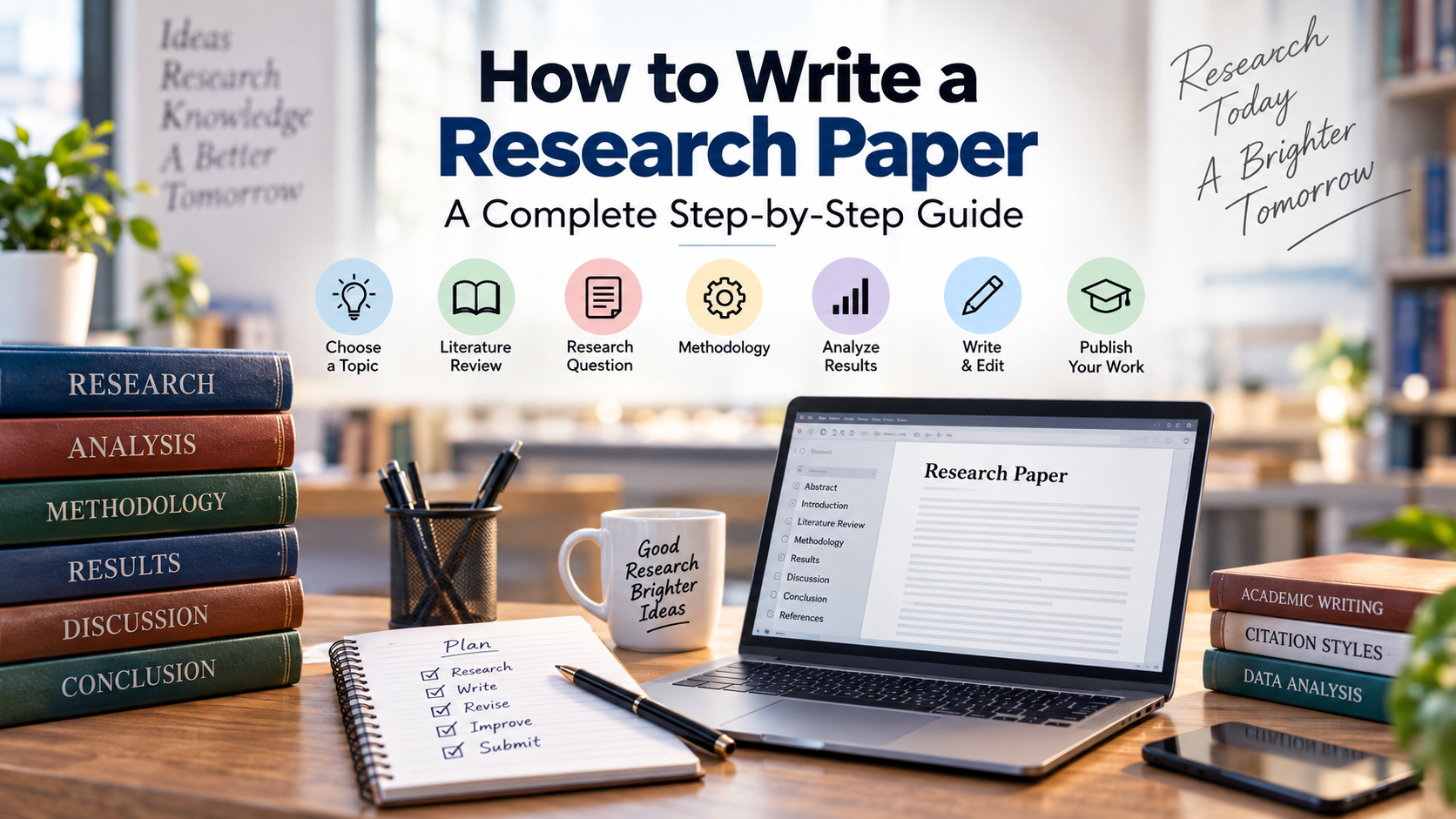

How to Write a Research Paper: A Step-by-Step Guide for Students and Researchers
______________________________________________________________________________________________________________________________________________________________
Writing a research paper is one of the most important academic skills that every student, scholar, and researcher should master. Whether you are working on a college assignment, preparing a journal article, or conducting independent research, a well-written research paper demonstrates your ability to analyze information, present evidence, and contribute to existing knowledge.
However, many beginners find research paper writing overwhelming. From selecting the right topic to formatting references correctly, the process involves multiple stages that require careful planning and attention to detail.
This comprehensive guide explains each step of writing a research paper, helping you produce a clear, organized, and academically sound manuscript.
______________________________________________________________________________________________________________________________________________________________
What Is a Research Paper?
A research paper is a formal academic document that presents original research, analysis, or interpretation of a specific topic. It is based on evidence collected from reliable sources, experiments, surveys, or observations.
The primary purpose of a research paper is to:
• Explore a research problem.
• Present findings supported by evidence.
• Contribute new knowledge or insights.
• Demonstrate critical thinking and analytical skills.
Research papers are widely used in schools, colleges, universities, research institutions, and scholarly journals.
______________________________________________________________________________________________________________________________________________________________
Types of Research Papers
Understanding the type of research paper you are writing helps determine the appropriate structure and methodology.
1. Analytical Research Paper
Analyzes information from multiple sources without necessarily arguing a position.
2. Argumentative Research Paper
Presents a claim supported by evidence and logical reasoning.
3. Experimental Research Paper
Reports findings from scientific experiments using a structured methodology.
4. Review Paper
Summarizes and evaluates existing research on a particular topic.
5. Case Study
Provides an in-depth examination of a specific individual, organization, event, or phenomenon.
______________________________________________________________________________________________________________________________________________________________
Step 1: Choose a Strong Research Topic
Selecting the right topic is the foundation of a successful research paper.
A good research topic should be:
• Interesting to you
• Relevant to your field
• Specific and focused
• Supported by sufficient scholarly literature
• Researchable within your available time and resources
Example
❌ Social Media
✅ Impact of Social Media Usage on Academic Performance among College Students
A focused topic makes research easier and produces more meaningful results.
______________________________________________________________________________________________________________________________________________________________
Step 2: Conduct a Literature Review
A literature review involves examining previous studies related to your research topic.
This step helps you:
• Understand existing knowledge
• Identify research gaps
• Avoid duplication
• Build a theoretical foundation
Reliable sources include:
• Peer-reviewed journal articles
• Academic books
• Government reports
• Conference proceedings
• University repositories
Avoid relying on blogs, unverified websites, or opinion-based articles as primary sources.
______________________________________________________________________________________________________________________________________________________________
Step 3: Develop a Research Question or Hypothesis
A research question defines what your study aims to answer.
Example:
Research Question
How does online learning affect student engagement in higher education?
A hypothesis is a testable prediction.
Example:
Students who participate in interactive online classes demonstrate higher academic engagement than students attending traditional lectures.
A clear research question keeps your study focused and organized.
______________________________________________________________________________________________________________________________________________________________
Step 4: Create a Research Paper Outline
Before writing, prepare an outline to organize your ideas.
A typical research paper includes:
• Title
• Abstract
• Introduction
• Literature Review
• Research Methodology
• Results
• Discussion
• Conclusion
• References
• Appendices (if applicable)
An outline saves time and ensures logical flow throughout the paper.
______________________________________________________________________________________________________________________________________________________________
Step 5: Write the Introduction
The introduction introduces readers to your research topic.
Include:
• Background information
• Problem statement
• Research objectives
• Research question
• Significance of the study
• Scope of research
A strong introduction should clearly explain why your research matters.
______________________________________________________________________________________________________________________________________________________________
Step 6: Write the Literature Review
The literature review discusses previous research relevant to your study.
It should:
• Summarize existing findings
• Compare different viewpoints
• Identify research gaps
• Explain how your research contributes to the field
Instead of listing studies individually, organize them by themes or concepts.
______________________________________________________________________________________________________________________________________________________________
Step 7: Describe Your Research Methodology
The methodology explains how the research was conducted.
Include:
• Research design
• Population and sample
• Data collection methods
• Research instruments
• Data analysis techniques
• Ethical considerations
This section should provide enough detail for another researcher to replicate your study.
______________________________________________________________________________________________________________________________________________________________
Step 8: Present the Results
The results section presents your findings objectively.
Use:
• Tables
• Charts
• Graphs
• Statistical analysis
Avoid interpreting the findings here; simply present the data clearly and accurately.
______________________________________________________________________________________________________________________________________________________________
Step 9: Discuss the Findings
The discussion explains what your results mean.
You should:
• Interpret the findings
• Compare them with previous studies
• Explain unexpected results
• Discuss practical implications
• Suggest future research directions
This section demonstrates your critical thinking and analytical skills.
______________________________________________________________________________________________________________________________________________________________
Step 10: Write the Conclusion
The conclusion summarizes your research without introducing new information.
Include:
• Summary of findings
• Research contributions
• Study limitations
• Recommendations
• Final remarks
A concise conclusion leaves readers with a clear understanding of your research.
______________________________________________________________________________________________________________________________________________________________
Step 11: Cite Your Sources Correctly
Proper citation acknowledges the work of other researchers and prevents plagiarism.
Common citation styles include:
• APA (7th Edition)
• MLA (9th Edition)
• Chicago
• Harvard
• IEEE
Reference management software such as Zotero, Mendeley, or EndNote can simplify citation and bibliography creation.
______________________________________________________________________________________________________________________________________________________________
Step 12: Edit and Proofread
Never submit your first draft without revision.
Check for:
• Grammar and spelling errors
• Sentence clarity
• Logical organization
• Consistent formatting
• Citation accuracy
• Typographical errors
Reading your paper aloud can help identify awkward sentences and improve readability.
______________________________________________________________________________________________________________________________________________________________
Step 13: Avoid Plagiarism
Plagiarism occurs when someone presents another person's work or ideas without proper acknowledgment.
To avoid plagiarism:
• Cite every source appropriately.
• Use quotation marks for direct quotes.
• Paraphrase correctly.
• Maintain accurate reference lists.
• Use plagiarism detection software before submission.
Academic integrity is essential for maintaining credibility and trust.
______________________________________________________________________________________________________________________________________________________________
Common Mistakes to Avoid
Many researchers make avoidable errors that reduce the quality of their papers.
Some common mistakes include:
• Choosing an overly broad topic
• Weak research questions
• Poor literature review
• Lack of reliable sources
• Inadequate data analysis
• Inconsistent formatting
• Incorrect citations
• Ignoring proofreading
Being aware of these mistakes can significantly improve your final manuscript.
______________________________________________________________________________________________________________________________________________________________
Useful Tools for Research Paper Writing
Several digital tools can simplify the research and writing process and help improve the quality of academic work.
• Literature Search: Google Scholar, Scopus
• Citation Management: Zotero, Mendeley
• Grammar Checking: Grammarly
• Plagiarism Detection: Turnitin, iThenticate
• Reference Formatting: Citation Machine
• Writing and Document Preparation: Microsoft Word, Google Docs
• Data Analysis: SPSS, R, Microsoft Excel
Using the right tools can save time, enhance accuracy, and improve the overall quality of your research paper.
Tips for Writing an Excellent Research Paper
Follow these best practices:
• Start your research early.
• Read extensively before writing.
• Use credible academic sources.
• Create a detailed outline.
• Write clear and concise sentences.
• Support every claim with evidence.
• Revise multiple times.
• Follow your institution's formatting guidelines.
• Seek feedback from supervisors or peers.
• Proofread carefully before submission.
Consistent practice is the key to becoming a confident academic writer.
______________________________________________________________________________________________________________________________________________________________
Frequently Asked Questions
- How long should a research paper be?
The length depends on academic requirements, but most undergraduate research papers range from 2,500 to 8,000 words, while journal articles typically range from 4,000 to 10,000 words.
How many references should a research paper include?
There is no fixed number. The quantity depends on your discipline, topic, and paper length. Always prioritize quality over quantity.
- Can I use Wikipedia as a source?
Wikipedia can provide a useful overview of a topic but should not be cited as a primary academic source. Instead, consult peer-reviewed journals, books, and authoritative publications.
- Which citation style should I use?
Follow the style required by your institution, supervisor, or target journal. APA is common in social sciences, MLA in humanities, IEEE in engineering, and Chicago in history.
______________________________________________________________________________________________________________________________________________________________
Final Thoughts
Writing a research paper may seem challenging at first, but breaking the process into manageable steps makes it much more approachable. Begin with a focused research topic, conduct a thorough literature review, develop a clear research question, organize your ideas through an outline, and write each section systematically. Finally, revise your work carefully, cite your sources accurately, and ensure your paper adheres to the required academic standards.
A well-written research paper not only improves your academic performance but also contributes valuable knowledge to your field of study. With careful planning, critical thinking, and consistent practice, anyone can develop strong research writing skills and produce high-quality scholarly work.