
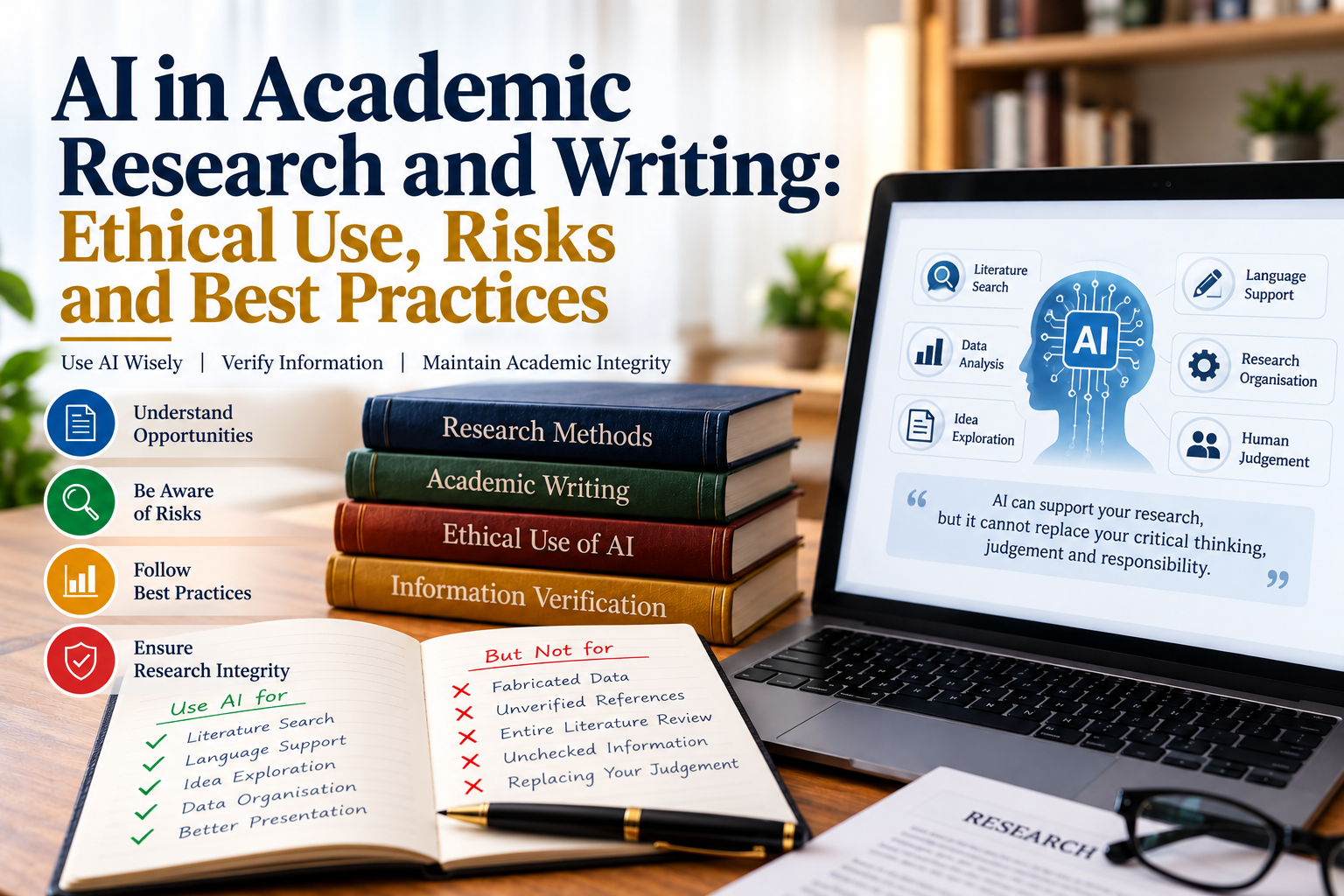
Artificial intelligence has gradually become part of everyday academic work. Researchers now use digital tools to search for literature, organise references, improve language, analyse information, manage data and prepare research material. The arrival of generative AI has expanded these possibilities even further
For academic researchers, however, convenience is only one part of the discussion
A research paper is not simply a well-written document. It represents the author’s intellectual contribution, evidence, interpretation and responsibility. A digital tool may help improve the way research is organised or communicated, but it cannot take responsibility for whether a claim is correct, a reference actually exists, a method is appropriate or a conclusion is supported by evidence
This distinction matters
The useful question is therefore not whether researchers should completely accept or completely reject AI. A better question is: where can AI genuinely assist research, and where must the researcher remain firmly in control?
WHAT DOES THE USE OF AI IN ACADEMIC RESEARCH MEAN?
AI in academic research covers a wide range of activities. Some applications have existed for years, while others have become widely accessible only recently
Researchers may encounter AI-supported tools while:
- searching and organising academic literature;
- improving grammar and readability;
- summarising notes or documents;
- generating keywords and search terms;
- translating research material;
- organising datasets;
- assisting with statistical or coding tasks;
- preparing structured information; and
- understanding unfamiliar concepts
- These activities are not ethically identical
Correcting a grammatical error is very different from asking a system to produce an entire literature review. Generating alternative keywords for a database search is different from allowing a tool to interpret research findings. Translating a sentence is different from generating a conclusion that the researcher has not independently reached
Responsible use therefore depends not only on which tool is used, but also on how it is used and how much intellectual work is delegated to it
AI CAN ASSIST RESEARCH, BUT IT CANNOT BE THE RESEARCHER
Authorship in academic publishing carries responsibility
When researchers place their names on a manuscript, they take responsibility for the accuracy of its content, the integrity of its data, the validity of its references and the conclusions presented to readers
An AI system cannot accept that responsibility
It cannot defend a methodology before an ethics committee, explain why particular data were collected, respond as an accountable author to an editor, or take responsibility when information turns out to be incorrect
AI should therefore be understood as an assistive tool rather than a substitute for the researcher’s intellectual contribution
WHERE AI CAN BE USEFUL IN RESEARCH
1. Improving Language and Readability
A researcher may have a strong study but find it difficult to communicate the work clearly, particularly when writing in a second or third language
Language-support tools can help identify grammatical errors, awkward sentences and unclear expressions. This can be useful when the ideas, arguments, findings and interpretation already belong to the researcher
The final text must still be reviewed carefully. A grammatically polished sentence is not necessarily scientifically correct
2. Organising Research Material
Large research projects can produce hundreds of notes, documents, references and pieces of information
Digital tools can help organise this material, group related information or identify themes that deserve closer examination
Such assistance may reduce routine work, but decisions about what evidence means should remain with the researcher
3. Developing Search Terms
Finding relevant literature often depends on using the right search terms
AI tools may help researchers identify synonyms, related terminology and alternative keywords that can later be used in academic databases and scholarly search engines
This can make literature searching more efficient
However, an AI-generated answer should not replace the actual process of locating, reading and evaluating published research
4. Understanding Difficult Concepts
Researchers occasionally encounter unfamiliar statistical, methodological or theoretical concepts
A simple explanation generated by a digital tool may provide a useful starting point
But it should remain a starting point
Important concepts should subsequently be checked against textbooks, original research papers, official documentation or other reliable academic sources
5. Assistance With Data and Coding Tasks
Depending on the discipline, researchers may use AI-supported systems for coding assistance, data organisation or exploratory analysis
These applications can save time, but researchers must understand what the tool is doing
Results should never be included in a research paper simply because software produced them. The researcher must be able to understand, verify and explain the analysis
WHERE AI USE BECOMES RISKY
The greatest problems usually arise when convenience begins to replace scholarly judgement
1. Generating References Without Verification
This is one of the most practical risks of using generative AI in research
A generated reference can look completely legitimate. An author’s name may appear plausible, the journal title may sound genuine and a DOI may resemble a real identifier
Yet the publication may not exist
Including invented or inaccurate references damages the credibility of a manuscript
Every reference should therefore be verified using the original publication, publisher website, DOI record or a reliable scholarly database before it is included in a research paper
2. Accepting Generated Information Without Checking It
AI-generated responses can sometimes sound confident even when the information is incomplete or incorrect
This creates a particular problem in academic writing because a sentence may sound authoritative while containing an inaccurate date, statistic, interpretation or scientific claim
Researchers should verify important factual claims using credible academic or primary sources
Fluent language should never be mistaken for reliable evidence
3. Outsourcing the Literature Review
A literature review is not simply a collection of summaries
Its purpose is to understand what has already been studied, where scholars agree or disagree, which methods have been used, what limitations exist and where meaningful research gaps remain
A researcher who depends entirely on generated summaries may miss important context, methodological weaknesses or contradictory findings contained in the original papers
Reading the literature remains part of doing research
4. Generating Results That Were Never Obtained
Research findings must come from the actual study
AI should never be used to invent participants, observations, survey responses, experimental outcomes, statistical results or other research data
Presenting fabricated data as genuine research is a serious violation of research integrity
No technology changes that principle
5. Allowing AI to Interpret Findings Without Researcher Judgement
A discussion section requires more than polished language
Researchers need to explain what their findings mean, compare them with earlier studies, consider alternative explanations, recognise limitations and determine whether the evidence supports their conclusions
These decisions require disciplinary knowledge and scholarly judgement
A tool may assist with organisation or language, but the interpretation must remain grounded in the researcher’s actual findings and understanding
AI AND PLAGIARISM ARE NOT THE SAME THING
AI-generated content and plagiarism are related to research integrity, but they should not automatically be treated as the same issue
Plagiarism concerns the inappropriate use or presentation of another person’s words, ideas or intellectual contributions without adequate acknowledgement
AI-related concerns may involve different questions, including authorship, disclosure, factual accuracy, fabricated references, originality and accountability
A manuscript could have a low similarity score and still contain serious problems if it includes inaccurate information, invented references or generated interpretations that the authors have not verified
Similarly, the presence of textual similarity does not automatically prove that AI was used
These issues should be evaluated separately and carefully
CAN AI-GENERATED CONTENT BE DETECTED ACCURATELY?
AI-detection tools are increasingly being used in educational and publishing environments, but their results require careful interpretation
Writing style varies considerably between authors. Researchers writing in a second language may use simple or highly structured sentences. Academic writing itself often follows predictable patterns
For these reasons, an automated AI-detection percentage should not be treated as unquestionable proof of misconduct
Editorial decisions should consider the manuscript as a whole, the journal’s policies, the nature of the concern and, where appropriate, clarification from the authors
Responsible research assessment requires judgement rather than dependence on a single software score
SHOULD AUTHORS DISCLOSE THE USE OF AI?
Researchers should first consult the policy of the journal, university, funding body or institution involved
Requirements may differ
Where disclosure is required, authors should explain the use of AI-assisted tools honestly and clearly
There is an important difference between saying that a tool was used for limited language improvement and using a system to generate substantial parts of a manuscript
Transparency helps editors understand how the research and manuscript were prepared
Researchers should not hide significant AI involvement when the applicable publication policy requires disclosure
CAN AI BE LISTED AS AN AUTHOR?
Academic authorship involves more than producing text
Authors are expected to approve the final manuscript, accept responsibility for the work, respond to questions about its accuracy and integrity, disclose conflicts where required and remain accountable after publication
An AI system cannot fulfil these responsibilities
For this reason, AI tools should not be treated as human authors of academic papers
Responsibility remains with the researchers whose names appear on the manuscript
AI SHOULD NOT REPLACE PRIMARY SOURCES
Suppose a researcher asks an AI system:
- “What did a particular study conclude?”
- The system provides a convincing answer
Should that generated response be cited as evidence of what the study found?
No
The researcher should locate the actual study, read the relevant section and cite the original publication
This principle is particularly important when dealing with:
- research findings;
- statistics;
- theoretical arguments;
- legal provisions;
- historical facts;
- clinical information;
- policy documents; and
- quotations
AI can help researchers find a direction. It should not become a substitute for the evidence itself
A SIMPLE TEST BEFORE USING AI-GENERATED MATERIAL
Before including AI-assisted material in a research paper, ask four questions:
- Do I understand this?
- Can I verify it?
- Can I identify reliable evidence supporting it?
- Am I willing to take academic responsibility for it?
If the answer to any of these questions is no, the material should not be included until it has been properly checked
GOOD PRACTICES FOR RESEARCHERS USING AI
Researchers who choose to use AI-assisted tools can reduce many risks by following a few practical principles
Use AI to assist rather than replace scholarly thinking
Verify factual claims independently
Never include a reference without confirming that it exists
Read original research papers rather than relying entirely on generated summaries
Do not upload confidential, unpublished or personally identifiable research information to external systems without understanding the relevant privacy and data-protection requirements
Do not generate or alter research data in ways that misrepresent what actually occurred
Review all AI-assisted text before including it in a manuscript
Follow the specific AI policy of the journal or institution
Disclose significant AI use when required
Most importantly, remain responsible for every sentence submitted under your name
CONFIDENTIALITY IS AN IMPORTANT BUT OFTEN IGNORED ISSUE
AI discussions often focus on writing, while confidentiality receives much less attention
Researchers may work with unpublished manuscripts, participant information, interview transcripts, institutional records, confidential datasets or commercially sensitive material
Uploading such information to an external AI service can create privacy, confidentiality or intellectual-property concerns depending on the service and the applicable institutional rules
Before uploading research material, researchers should understand how the service stores, processes and uses submitted information
When confidential information is involved, institutional and ethical requirements should take priority over convenience
WHAT SHOULD AUTHORS CHECK BEFORE SUBMITTING A RESEARCH PAPER?
Before submitting a manuscript, authors should conduct a final review of any AI-assisted work
Ask:
Are all facts verified?
Do all cited references actually exist?
Have I personally read the important sources used in the paper?
Are the data and results entirely based on the actual research?
Does the discussion reflect my interpretation of the findings?
Have I complied with the journal’s AI policy?
Is disclosure required?
Have I protected confidential research information?
Can I defend and explain every important claim in the manuscript?
If the answer to the final question is no, the manuscript probably needs further review
THE ROLE OF JOURNALS AND EDITORS
Responsible use of AI is not only an author issue
Academic journals also need clear and proportionate policies
Authors should know what forms of AI assistance are permitted, what must be disclosed and what practices are unacceptable
Editors should also avoid treating automated detection scores as substitutes for editorial judgement
Research integrity is best protected when expectations are transparent and concerns are assessed fairly
THE HUMAN ELEMENT OF RESEARCH STILL MATTERS
Research begins with curiosity
A researcher notices a problem, asks a question, studies what others have discovered, chooses an appropriate method, collects or examines evidence, interprets findings and decides what those findings contribute to existing knowledge
Technology can assist almost every stage of this journey
It can make certain tasks faster. It can help organise information. It can improve language. It can sometimes help researchers see possibilities they had not considered
But speed is not the purpose of research
The purpose is to produce knowledge that readers can examine, question and trust
That requires human judgement, intellectual honesty and accountability
FINAL THOUGHTS
Artificial intelligence is likely to remain part of the research environment
The challenge for researchers is therefore not to pretend that these tools do not exist, nor to use them without limits
The more useful approach is to understand where technology genuinely helps and where scholarly responsibility must remain human
AI can help a researcher improve a sentence
It cannot decide whether the underlying argument is true
It can suggest a search term
It cannot replace reading the literature
It can organise information
It cannot take responsibility for the integrity of a published paper
Good research has always depended on careful questioning, reliable evidence, transparent methods and honest reporting. New technology does not make these principles less important
It makes them more important
FREQUENTLY ASKED QUESTIONS
What is AI in academic research?
AI in academic research refers to the use of artificial intelligence-supported tools for activities such as literature searching, language assistance, information organisation, coding, data analysis and other research-related tasks
Can researchers use AI for academic writing?
AI-assisted tools may be used for certain purposes depending on the policies of the relevant journal or institution. Researchers remain responsible for verifying the accuracy, originality and integrity of everything included in their manuscripts
Can AI be used to write a literature review?
AI may help organise ideas or identify possible search terms, but it should not replace reading, evaluating and synthesising original academic literature
Is AI-generated text plagiarism?
Not automatically. Plagiarism and AI-generated content involve different research-integrity questions. AI use may raise concerns relating to disclosure, accuracy, originality, authorship and accountability even when textual similarity is low
Can AI-generated references be trusted?
References generated by AI should never be accepted without verification. Researchers should confirm every reference using the original publication or a reliable scholarly source
Can AI be listed as an author of a research paper?
AI systems cannot take responsibility for a manuscript or fulfil the accountability expected of academic authors. Responsibility for the published work remains with the human authors
Should researchers disclose AI use?
Researchers should follow the policy of the journal, institution or other relevant authority. Where disclosure is required, the nature and extent of AI assistance should be stated transparently
ABOUT BJDD
BODHIVRUKSHA JOURNAL OF DIVERSE DISCIPLINE (BJDD) is a peer-reviewed, open-access, multidisciplinary and multilingual academic research journal
ISSN: 3139-1486 (Online) | ISSN: 3139-9819 (Print)
The journal provides a platform for original scholarly work across diverse fields, including Humanities, Social Sciences, Education, Commerce and Management, Science and Technology, Computer Science, Artificial Intelligence, Law, Environmental Studies, Agriculture, Health Sciences, and interdisciplinary research
Researchers interested in submitting original scholarly work are encouraged to review the journal’s current Author Guidelines, Publication Ethics Policies, and Manuscript Requirements before submission
Learn. Research. Cite Responsibly. Publish Ethically