Originality is one of the foundations of credible research. Every research paper builds on existing knowledge, but researchers are expected to clearly distinguish between what they have learned from previous scholarship and what they themselves contribute
This is where plagiarism becomes an important concern
Plagiarism is often understood simply as copying someone else's words. In academic research, however, the issue is much broader. A researcher may improperly use another person's ideas, arguments, data, methods, images, or written material without adequate acknowledgement. Problems can also arise when authors reuse substantial parts of their own previously published work without appropriate disclosure
For students, research scholars, faculty members, and early-career researchers, understanding plagiarism is therefore not merely about obtaining a low similarity percentage. It is about learning how to participate responsibly in scholarly communication
This guide explains what plagiarism means in research, its common forms, how plagiarism and similarity differ, how manuscripts are screened, and the practical steps researchers can take to maintain originality
What Is Plagiarism in Research?
In research writing, plagiarism occurs when material or intellectual contributions originating from another source are presented without appropriate acknowledgement
The material involved may include:
- words or sentences;
- ideas and arguments;
- research methods;
- data or results;
- tables and figures;
- images and illustrations;
- models or frameworks; or
- other identifiable intellectual contributions
The U.S. Office of Research Integrity (ORI), for example, defines plagiarism in the context of research misconduct as the appropriation of another person's ideas, processes, results, or words without appropriate credit
This definition highlights an important point: plagiarism is not restricted to word-for-word copying
A researcher can change the wording of a paragraph and still fail to acknowledge the original intellectual source. Conversely, the appearance of similar technical terminology does not automatically establish plagiarism
Context, attribution, originality, and the nature of the reused material all matter
Why Is Plagiarism a Serious Issue in Academic Research?
Research depends heavily on trust
Readers trust that authors have represented their contribution accurately. Reviewers assume that a submitted manuscript presents original scholarly work unless previous material is properly identified. Editors depend on authors to disclose relevant earlier publications and sources
Plagiarism can damage this trust
Depending on its nature and seriousness, plagiarism may result in manuscript revision, rejection, correction of a published article, institutional investigation, or retraction
More importantly, plagiarism makes it difficult to determine where an idea or contribution actually originated
Proper attribution is therefore not simply a formatting requirement. It allows readers to trace evidence, examine earlier scholarship, understand how knowledge has developed, and distinguish an author's contribution from the work on which it is based
Common Types of Plagiarism in Research
Plagiarism does not always appear in the same form. Researchers should be familiar with several common situations
1. Direct Plagiarism
Direct plagiarism occurs when an author reproduces another person's words substantially or verbatim without appropriate acknowledgement
Example
Original source:
- > Digital technologies have significantly transformed communication between teachers and students
Problematic version:
- > Digital technologies have significantly transformed communication between teachers and students
If the sentence is reproduced from another author without quotation or appropriate attribution, it may constitute direct plagiarism
Changing only a few words does not necessarily solve the problem
2. Mosaic or Patchwork Plagiarism
Patchwork plagiarism occurs when words, phrases, sentence structures, or ideas from one or several sources are combined into a new paragraph without sufficient attribution
It can be difficult to notice because the resulting paragraph may look newly written
For example, a writer may take one sentence structure from Article A, terminology from Article B, and an argument from Article C and combine them without acknowledging the original sources
The paragraph may technically be "new," but its intellectual construction is not adequately original
3. Inadequate Paraphrasing
Paraphrasing means explaining information or an idea genuinely in your own language and structure while preserving the meaning of the source
Simply replacing several words with synonyms is not effective paraphrasing
Weak paraphrasing
Original:
- > Social media has changed the way university students communicate and access information
Weak version:
- > Social networking platforms have altered how college students communicate and obtain information
Although some words have changed, the structure remains very close to the original
A stronger approach is to first understand the idea, set the source aside, explain the concept independently, and then cite the original work
4. Idea Plagiarism
Ideas themselves can require attribution
Suppose a researcher encounters an original theoretical interpretation, research framework, hypothesis, or analytical approach in another scholar's work
Rewriting that idea completely in new words does not automatically make it the researcher's own intellectual contribution
If the idea originated from another source and is not common knowledge within the discipline, the source should normally be acknowledged
This is why good citation practice goes beyond identifying copied sentences
5. Source-Based Plagiarism and Misleading Citation
Problems may also arise when citations do not accurately represent the sources used
Examples include:
- citing a source that was not actually consulted;
referring to a secondary source as though the original work had been read;
attributing an idea to the wrong publication;
using references that do not support the statement being made; or
omitting the actual source from which material was obtained
Accurate referencing requires more than adding citations to a manuscript. Each citation should have a clear relationship with the claim it supports
6. Plagiarism of Data, Tables, Figures or Images
Researchers sometimes focus exclusively on text similarity and overlook non-textual material
Using another person's table, graph, image, diagram, dataset, figure, or other original material without proper attribution or required permission can create serious ethical and copyright concerns
When using such material, researchers should determine:
- who created the original material;
- whether it can legally be reused;
- whether permission is required;
- how the source should be cited; and
- whether the material has been reproduced or adapted
A citation alone does not necessarily provide legal permission to reproduce copyrighted material
7. Self-Plagiarism and Text Recycling
The term "self-plagiarism" is commonly used when authors reuse substantial portions of their own previous writing without appropriate disclosure
The issue is slightly different from taking another person's work because the author is reusing their own material. Nevertheless, undisclosed recycling can mislead editors and readers about the originality of a manuscript
Not every repeated phrase is automatically problematic. Standard descriptions of methods, technical terminology, or unavoidable expressions may naturally resemble earlier writing
The concern becomes more significant when substantial text, data, analysis, or findings are reused while being presented as new work
Transparency is essential
8. Duplicate or Redundant Publication
Duplicate publication is related to, but not identical with, plagiarism
It occurs when substantially overlapping work is published again without clear disclosure of the earlier publication
Authors should also avoid submitting the same manuscript simultaneously to multiple journals
Researchers working with the same dataset across several papers should ensure that each manuscript addresses a sufficiently distinct research question and appropriately cites related publications
Dividing one study into multiple minimally different papers merely to increase publication count can also raise concerns about redundant publication
Plagiarism and Similarity Are Not the Same Thing
This distinction is extremely important
A similarity score measures textual overlap detected between a manuscript and material available in the comparison database of a particular software system
Plagiarism, by contrast, is an ethical judgment concerning inappropriate use or presentation of another person's intellectual work
Therefore:
- Similarity ≠ Plagiarism
- A manuscript can contain legitimate similarity
Examples may include:
- references and bibliography;
- names of institutions;
- technical terminology;
- standard methodological expressions;
- titles of laws or official documents;
- properly quoted material; and
- commonly used academic phrases
At the same time, a manuscript could potentially contain a serious attribution problem even when its overall similarity percentage appears relatively low
Imagine a 5,000-word paper in which only one paragraph is taken from another researcher. The overall similarity score might remain small, but that paragraph could contain the central original argument of the source
This is why plagiarism detection should never be reduced to a single percentage
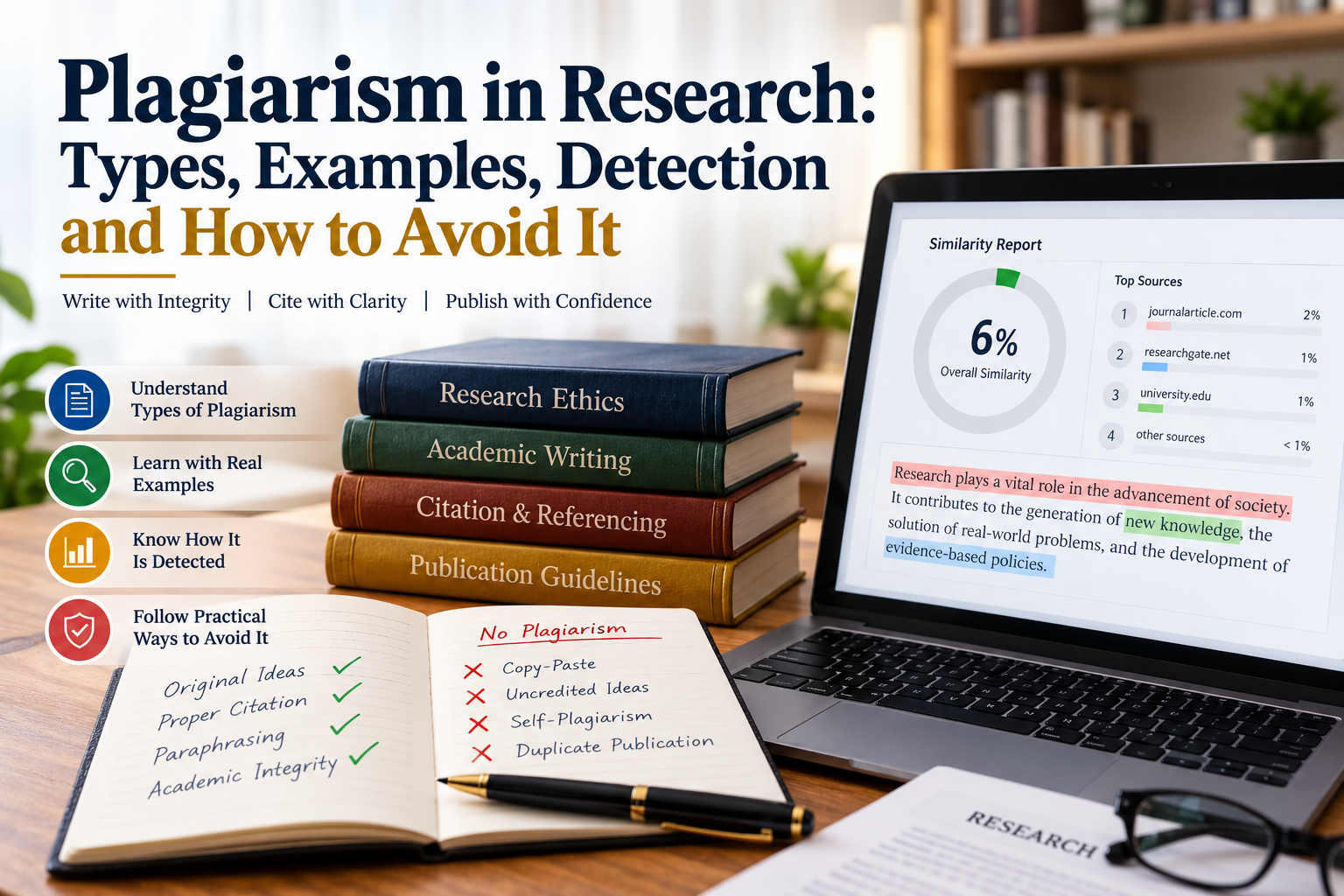
What Does a Similarity Report Actually Show?
Similarity-detection software typically compares submitted text against material available in its databases and highlights matching or closely corresponding passages
A report may show:
- an overall similarity percentage;
- individual matching sources;
- matched passages;
- the percentage associated with individual sources; and
- exclusions such as references or quoted material, depending on the settings used
- The report is evidence for evaluation—not the final ethical judgment
Editors, reviewers, institutions, or researchers should examine the nature of the matches before reaching conclusions
How Is Plagiarism Detected?
Plagiarism and unattributed overlap may be identified through several methods
1. Text-Matching Software
Academic institutions and publishers commonly use similarity-detection systems to identify textual overlap
These systems can be valuable screening tools, particularly for locating passages that require closer examination
However, software does not fully understand scholarly context. Human evaluation remains necessary
2. Editorial Screening
Journal editors may examine manuscripts for unusual changes in writing style, inconsistent terminology, mismatched citations, questionable figures, or passages that appear inconsistent with the rest of the manuscript
Experienced editors and reviewers sometimes recognize material from familiar publications within their discipline
3. Reference Verification
References can reveal additional concerns
Editors or reviewers may check whether:
- cited papers actually exist;
- bibliographic details are accurate;
- sources support the claims attributed to them;
- citations correspond with the reference list; and
- important original sources have been acknowledged
- Peer Review
- Subject experts often have deep familiarity with the literature in their fields
During peer review, they may recognize an established argument, framework, dataset, or passage that has not been appropriately credited
Plagiarism screening is therefore not merely a software-based process. It forms part of a broader system of research-quality and integrity checks
How to Avoid Plagiarism in a Research Paper
Avoiding plagiarism begins much earlier than the final plagiarism check
1. Keep Track of Sources While Reading
One of the most common causes of citation problems is poor note-taking
While conducting a literature review, record the complete bibliographic information for every useful source
Clearly distinguish among:
- your own observations;
- paraphrased notes;
- direct quotations; and
- ideas taken from a source
Do not wait until the manuscript is complete to reconstruct the reference list
2. Cite Ideas, Not Only Quotations
Researchers sometimes assume that citations are necessary only for copied words
That is incorrect
If a theory, argument, model, finding, dataset, or distinctive idea comes from another researcher, acknowledge the source even when you describe it entirely in your own words
3. Learn to Paraphrase Properly
Good paraphrasing involves understanding rather than replacing words
A practical method is:
- Read → Understand → Set the source aside → Write independently → Compare → Cite
After reading a source, ask yourself:
"How would I explain this idea to another researcher without looking at the original sentence?"
Write that explanation first. Then compare it with the source to ensure that you have not unintentionally reproduced its language or structure
Finally, add the appropriate citation
4. Use Direct Quotations Sparingly
When exact wording is genuinely important, quotation marks or the quotation format required by the relevant referencing style should be used along with proper attribution
Research papers generally benefit from synthesis and analysis rather than excessive quotation
Authors should demonstrate that they understand the literature instead of assembling large sections of other people's words
5. Cite the Original Source Whenever Possible
Researchers often encounter an important study through another paper
Where practical, locate and read the original source before citing it
This reduces the risk of repeating an inaccurate interpretation and allows you to understand the original research in context
6. Maintain an Accurate Reference List
Every in-text citation should correspond to the appropriate reference entry, and every reference should be accurate enough for readers to locate the source
Before submission, verify:
- author names;
- article or chapter titles;
- journal or book titles;
- publication year;
- volume and issue;
- page numbers;
- DOI, where applicable; and
- consistency with the required citation style
- Be Transparent About Your Previous Publications
If your new manuscript is related to work you have already published, cite the earlier paper and disclose relevant overlap where necessary
Do not attempt to disguise previously published material simply by changing wording
Transparency allows editors to make informed decisions about whether the new manuscript contains a sufficiently original contribution
8. Check Tables, Figures and Images Separately
Before submission, review every non-textual element
Ask:
Did I create this myself?
If not:
Have I acknowledged the source, and do I have permission to use or adapt it where required?
This simple check can prevent problems that a standard text-similarity report may not identify
9. Use Similarity Detection as a Diagnostic Tool
A similarity report should help researchers improve their manuscripts, not simply chase a lower percentage
When reviewing a report, examine:
- where each match occurs;
- why the text matches;
- whether a citation is present;
- whether paraphrasing is genuinely independent;
- whether quotation is required; and
- whether the underlying idea has been attributed
- The goal is not to mechanically eliminate every highlighted sentence
- The goal is to ensure that the manuscript represents sources honestly
Can a Research Paper Have 0% Similarity?
Possibly, but a 0% similarity score should not be treated as the universal definition of an original research paper
Academic writing naturally contains standardized terminology, references, names, technical expressions, and phrases that may appear elsewhere
A researcher should therefore focus on **ethical originality**, not an artificial pursuit of zero textual overlap
Similarly, no single universal percentage determines whether a manuscript is plagiarized
Different journals and institutions may establish their own screening requirements, but ethical assessment should still consider the nature and context of the matching material
Is Using AI the Same as Plagiarism?
Not necessarily
AI-assisted writing and plagiarism are related to research integrity but are not identical issues
A manuscript may contain AI-generated text that does not match existing sources and therefore produces a low similarity score. That does not automatically establish that the manuscript meets a journal's policies regarding authorship, disclosure, accuracy, originality, or responsible AI use
Likewise, AI tools can produce incorrect references, unsupported claims, or language that closely resembles existing material
Researchers remain responsible for verifying their manuscripts and complying with the AI policy of the journal to which they submit
AI should never be treated as a substitute for scholarly judgment, genuine research, proper citation, or author accountability
What Should Authors Do Before Submitting a Manuscript?
Before journal submission, authors should conduct a final research-integrity review
Check whether:
- all borrowed ideas have been acknowledged;
- paraphrased material is genuinely rewritten;
- direct quotations are clearly identified;
- all citations appear in the reference list;
- references actually support the claims made;
- reused tables, figures, and images are appropriately credited;
- related previous publications have been disclosed;
- substantial sections of previous work have not been presented as new;
- similarity matches have been reviewed individually; and
- all co-authors have reviewed and approved the final manuscript
This final check is often more valuable than simply asking, "What is my plagiarism percentage?"
A better question is:
- "Have I represented every source and every contribution honestly?"
- Plagiarism Screening at BJDD
BODHIVRUKSHA JOURNAL OF DIVERSE DISCIPLINE (BJDD) places importance on originality, research ethics, and responsible scholarly publishing
Submitted manuscripts undergo editorial screening, including plagiarism/similarity assessment, as part of the journal's publication process
Authors submitting to BJDD are expected to provide original and unpublished work, acknowledge sources appropriately, avoid plagiarism and duplicate publication, and comply with the journal's publication ethics and author guidelines
BJDD currently requires manuscripts to remain within its prescribed similarity limit, subject to editorial assessment and applicable exclusions. Authors should consult the latest Author Guidelines and Publication Policies before submission because journal requirements may be updated periodically
Importantly, meeting a numerical similarity requirement does not by itself guarantee acceptance. Manuscripts are also evaluated for originality, methodology, academic quality, relevance, ethical compliance, and overall scholarly contribution
Final Thoughts
Plagiarism prevention should not begin five minutes before manuscript submission
It begins when researchers take their first literature-review notes
Responsible research requires authors to understand where ideas come from, distinguish their own contribution from existing scholarship, acknowledge intellectual influences, cite accurately, and communicate their findings transparently
Similarity-detection technology can assist this process, but software cannot replace academic judgment
For researchers, the most useful principle is simple:
Do not write merely to achieve a low similarity score. Write so that a reader can clearly understand what came from previous scholarship and what you have contributed to it.**
That distinction is at the heart of academic integrity
Frequently Asked Questions
What is plagiarism in research?
Plagiarism is the inappropriate use or presentation of another person's words, ideas, processes, results, or other intellectual contributions without adequate acknowledgement
Is plagiarism the same as similarity?
No. Similarity indicates textual overlap detected by software, while plagiarism involves an ethical assessment of how another source's material or intellectual contribution has been used
Is paraphrasing enough to avoid plagiarism?
Only when it is done properly. Changing a few words is insufficient. Researchers should understand the source, express the idea independently, and cite the original source
Can I plagiarize my own work?
Substantial undisclosed reuse of previously published material is commonly described as self-plagiarism or text recycling. Duplicate or redundant publication can also create publication-ethics concerns
Does citing a source allow me to copy its paragraph?
Not automatically. A citation acknowledges the source but does not make verbatim copying acceptable. Exact wording generally requires appropriate quotation, and copyrighted material may also involve permission requirements
Does a low similarity score guarantee that a paper is plagiarism-free?
No. A low overall percentage can still contain problematic unattributed material. Similarity reports should therefore be reviewed qualitatively rather than interpreted only by their total percentage
How can researchers avoid plagiarism?
Maintain accurate research notes, cite sources while writing, paraphrase genuinely, use quotations appropriately, verify references, disclose previous related work, check figures and tables, and carefully review similarity reports before submission
Does BJDD check submitted manuscripts for plagiarism?
Yes. BJDD's current author information and publication policies state that submitted manuscripts undergo plagiarism screening and editorial review. Authors should review the journal's latest guidelines before submitting
About BJDD
BODHIVRUKSHA JOURNAL OF DIVERSE DISCIPLINE (BJDD) is a peer-reviewed, open-access, multidisciplinary and multilingual academic research journal
ISSN: 3139-1486 (Online) | ISSN: 3139-9819 (Print)
The journal provides a platform for original scholarly work across diverse fields, including Humanities, Social Sciences, Education, Commerce and Management, Science and Technology, Computer Science, Artificial Intelligence, Law, Environmental Studies, Agriculture, Health Sciences, and interdisciplinary research
Researchers interested in submitting original scholarly work are encouraged to review the journal's current Author Guidelines, Publication Ethics Policies, and Manuscript Requirements before submission
Learn. Research. Cite Responsibly. Publish Ethically