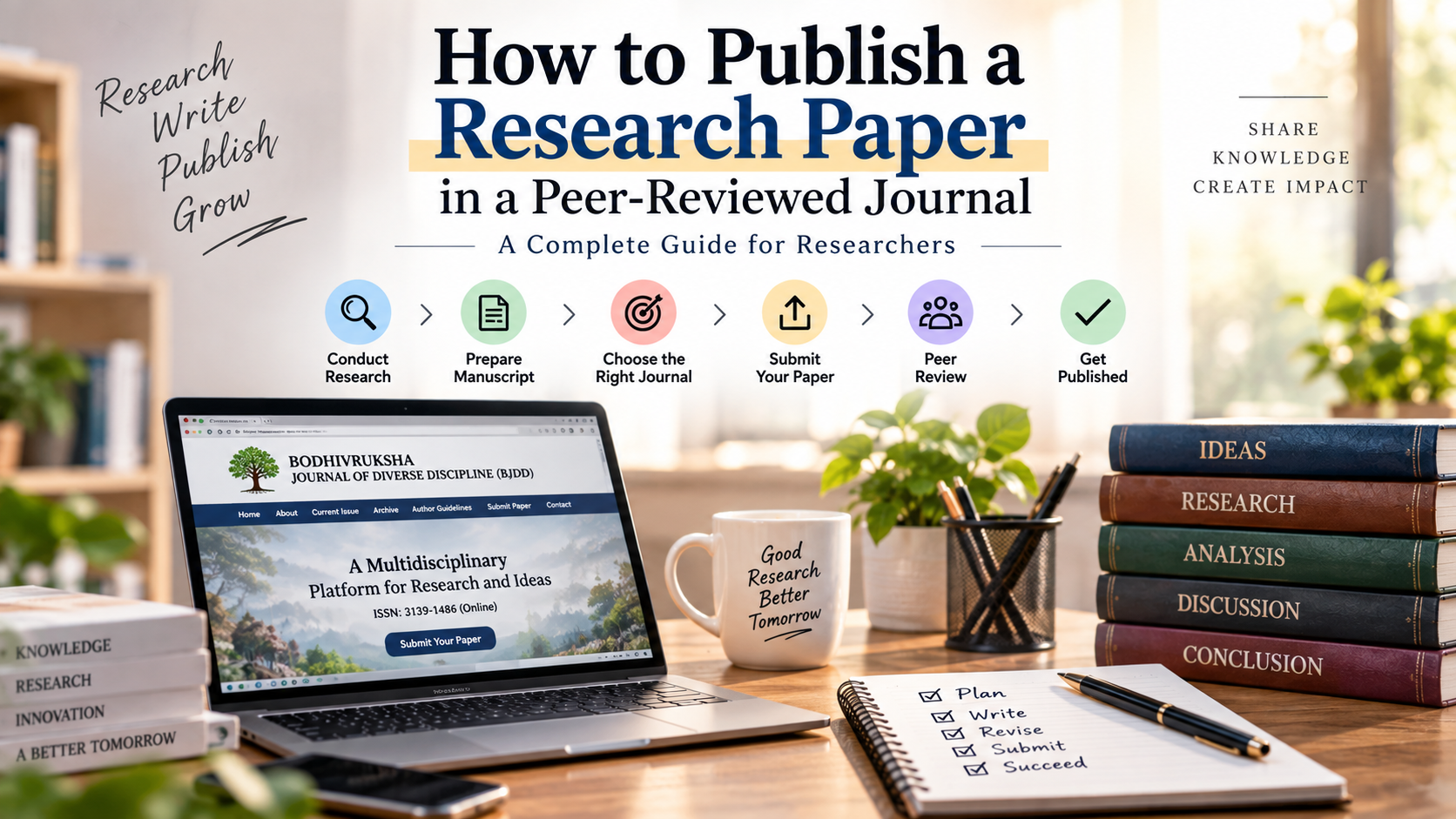
Publishing a research paper in a peer-reviewed journal is an important milestone for students, research scholars, academicians, and professionals. A journal publication allows researchers to communicate their findings, contribute to academic knowledge, and make their work accessible to the wider scholarly community
For first-time authors, however, the publication process may appear complicated. Questions such as Which journal should I choose? How should I prepare my manuscript? What happens during peer review? and How do I submit my paper? are common
This step-by-step guide explains the complete research paper publication process, from manuscript preparation to final publication
What Is a Peer-Reviewed Journal?
A peer-reviewed journal is an academic publication in which submitted manuscripts are evaluated by experts or reviewers familiar with the relevant subject area
The peer-review process helps evaluate the academic quality, relevance, methodology, originality, and presentation of a research manuscript before publication
Depending on the journal's editorial policy, authors may receive one of several decisions, such as:
- Accepted
- Accepted with minor revisions
- Major revisions required
- Resubmission required
- Rejected
Peer review is therefore an important part of scholarly publishing and academic quality control
Step 1: Complete Your Research Work
Before preparing a manuscript for publication, ensure that your research is complete and properly documented
Your study should have:
- A clearly defined research problem
- Specific research objectives
- An appropriate research methodology
- Reliable data or evidence
- Proper analysis
- Clearly presented findings
- A meaningful conclusion
- Avoid rushing to submit incomplete research simply to obtain a publication
Step 2: Prepare Your Research Paper
Once the research work is complete, organize it into a structured academic manuscript
Although the exact format varies across disciplines and journals, a typical research paper may contain:
- Title
- Author Name(s) and Affiliation(s)
- Abstract
- Keywords
- Introduction
- Review of Literature
- Research Methodology
- Results
- Discussion
- Conclusion
- References
Some journals or disciplines may require a different structure, so always check the journal's author guidelines before submission
Step 3: Choose the Right Journal
Selecting an appropriate journal is one of the most important decisions in the publication process
Before submitting your manuscript, examine:
- Aim and scope of the journal
- Subject areas covered
- Type of articles accepted
- Peer-review process
- Publication frequency
- Author guidelines
- Publication ethics
- ISSN and journal information
- Editorial policies
- Your research topic should fit the journal's stated scope
Submitting a manuscript to an unrelated journal may result in rejection before the peer-review process even begins
Step 4: Read the Author Guidelines Carefully
Every journal has its own manuscript preparation and submission requirements
Before submission, check requirements related to:
- Manuscript structure
- Word limit
- Abstract
- Keywords
- Tables and figures
- Citation style
- Reference format
- Author information
- File format
- Declaration requirements
Following the author guidelines carefully can help prevent unnecessary delays during editorial screening
Step 5: Check Your Manuscript Before Submission
Before uploading your paper, conduct a final review
Check for:
- Grammar and spelling errors
- Incorrect citations
- Missing references
- Formatting inconsistencies
- Unclear tables or figures
- Incomplete author information
- Ethical issues
- Improper acknowledgment of sources
Authors should also ensure that the manuscript represents their own scholarly work and that all external ideas, data, and sources are properly acknowledged
Step 6: Submit Your Research Paper
Once the manuscript is ready, submit it through the journal's official submission system or the method specified by the journal
Authors may generally be required to provide:
- Research paper/manuscript
- Full name of author(s)
- Institutional affiliation
- Email address
- Contact details
- Research discipline
- Manuscript title
- Additional declarations, where required
- Always verify all information before completing the submission
Step 7: Initial Editorial Screening
After submission, the editorial team generally conducts a preliminary evaluation
During this stage, the manuscript may be checked for:
- Relevance to the journal's scope
- Basic manuscript structure
- Academic presentation
- Compliance with author guidelines
- Completeness of submission
- Ethical or originality concerns
A manuscript that passes the initial editorial screening can proceed to the next stage of evaluation
Step 8: Peer Review
Peer review is a key stage of academic publishing
The manuscript is evaluated by appropriate reviewer(s), depending on the journal's peer-review policy
Reviewers may evaluate aspects such as:
- Relevance of the research topic
- Research objectives
- Methodology
- Data and analysis
- Interpretation of results
- Academic contribution
- Quality of references
- Overall presentation
- Based on the evaluation, reviewers may recommend acceptance, revision, or rejection
Step 9: Respond to Reviewer Comments
Receiving revision comments is a normal part of scholarly publishing
If revisions are requested:
- Read every comment carefully
- Address each relevant suggestion
- Make necessary corrections
- Clearly explain substantial changes where required
- Maintain a professional academic tone
- Submit the revised manuscript within the specified period
Reviewer comments can help improve the clarity and overall quality of a manuscript
Step 10: Acceptance of the Research Paper
If the manuscript successfully completes the editorial and peer-review process and meets the journal's requirements, it may be accepted for publication
However, acceptance and publication are not necessarily the same stage
After acceptance, the manuscript may still undergo processes such as:
- Final formatting
- Proofreading
- Author verification
- Metadata preparation
- Final editorial checks
The article should be considered published only after it has been officially released by the journal
Step 11: Publication in the Journal Issue
After completing the required publication process, the research paper is published in the appropriate journal issue
The published article may contain bibliographic information such as:
- Article title
- Author details
- Abstract
- Keywords
- Volume and issue
- Publication date
- Page details, where applicable
- References
- Article PDF or full text, depending on the journal
Once published, researchers can cite and share their article according to the journal's policies
Common Mistakes to Avoid When Submitting a Research Paper
Many publication problems can be prevented before submission
Avoid:
- Selecting a journal outside your research field
- Ignoring author guidelines
- Submitting an incomplete manuscript
- Using incorrect references
- Poor manuscript formatting
- Inadequate proofreading
- Failing to respond properly to reviewer comments
- Providing incorrect author information
- Submitting the same manuscript simultaneously to multiple journals where prohibited
- Careful manuscript preparation can make the submission and review process much smoother
- How to Choose a Genuine Academic Journal
- Researchers should carefully evaluate a journal before submitting their work
Check whether the journal provides clear information about:
- Journal title
- ISSN
- Publisher
- Editorial Board
- Aim and Scope
- Peer-review process
- Publication ethics
- Author guidelines
- Contact information
- Current and previous issues
Authors should rely on information available through the journal's official website and independently verify claims about indexing or recognition where necessary
Looking for a Multidisciplinary Journal for Your Research?
Researchers working across different academic disciplines may consider submitting suitable manuscripts to the BODHIVRUKSHA JOURNAL OF DIVERSE DISCIPLINE (BJDD)
About BJDD
Journal: BODHIVRUKSHA JOURNAL OF DIVERSE DISCIPLINE
Abbreviation: BJDD
ISSN: 3139-1486 (Online)
Publication: Peer-Reviewed Journal
Frequency: Bi-monthly
Publisher: Eagle Leap Publication
BJDD provides a scholarly platform for researchers, academicians, students, and professionals to communicate research and academic work across disciplines covered by the journal
Authors should review the journal's current Aim & Scope, Author Guidelines, publication policies, and submission requirements before submitting a manuscript
Submit Your Research Paper to BJDD
Have a manuscript ready for publication?
Explore the BODHIVRUKSHA JOURNAL OF DIVERSE DISCIPLINE (BJDD) and check whether your research aligns with the journal's scope
Before Submission:
- ✓ Check the Aim & Scope
- ✓ Read the Author Guidelines
- ✓ Prepare your manuscript
- ✓ Verify citations and references
- ✓ Review publication policies
- ✓ Submit through the official BJDD submission page
Ready to Submit?
Visit the Submit Paper section on the official BJDD website to begin your manuscript submission
Frequently Asked Questions
Can students publish research papers in journals?
Yes. Students and research scholars can submit research work to journals, provided the manuscript meets the journal's scope, academic standards, ethical requirements, and submission guidelines
Does submission mean my paper is accepted?
No. Submission only begins the journal's evaluation process. The manuscript may undergo editorial screening, peer review, revision, and other checks before an acceptance decision is made
Is an accepted paper immediately published?
Not necessarily. Acceptance and publication are separate stages. An accepted manuscript may still require formatting, proofreading, verification, and final editorial processing before publication
What should I check before choosing a journal?
Check the journal's Aim & Scope, ISSN, editorial information, peer-review policy, publication ethics, author guidelines, previous issues, and official contact information
How can I improve my chances of successful publication?
Choose a journal relevant to your research, follow its author guidelines carefully, use appropriate research methods, present your findings clearly, cite sources accurately, proofread your manuscript, and respond carefully to editorial or reviewer comments
Final Thoughts
Publishing a research paper is a systematic process that involves much more than simply uploading a manuscript
Researchers should begin by conducting meaningful research, prepare the manuscript according to academic standards, select an appropriate journal, follow author guidelines, participate constructively in the peer-review process, and complete revisions carefully
Choosing the right journal and preparing your manuscript properly can make the publication journey clearer and more efficient
If your research falls within the multidisciplinary scope of the BODHIVRUKSHA JOURNAL OF DIVERSE DISCIPLINE (BJDD), review the journal's guidelines and consider submitting your manuscript through the official submission process